Príspevky

Zobrazujú sa príspevky so štítkom cipher machines

The Unsung Heroes of Enigma: Beyond Alan Turing

Obraz
When we talk about breaking the Enigma cipher machine, Alan Turing’s name often takes center stage in popular media and history books. His brilliance in Bletchley Park and contributions to computer science are undeniable, but the story of Enigma’s decryption is far richer—and more international—than the spotlight on Turing suggests. In this post, we’ll shine a light on the critical contributions of Polish and Czechoslovak cryptographers, who laid the groundwork for cracking the German cipher machine and deserve their place in the narrative. The Polish Pioneers: Rejewski, Zygalski, and Różycki Long before Turing entered the scene, three Polish mathematicians—Marian Rejewski, Henryk Zygalski, and Jerzy Różycki—achieved a monumental breakthrough. In December 1932, working in Poland’s Cipher Bureau ( Biuro Szyfrów ), they cracked the military version of the Enigma, complete with its additional security feature, the plugboard ( steckerbrett ). Using advanced mathematical techniques, particu...

Spanish Embassy's cipher machine break by Czechoslovakian Secret Service and KGB

Obraz
How the Czechoslovak secret service ŠtB breaks the encryption machine Gretag TC 803 at the Spanish embassy in Prague: https://www.info.cz/zpravodajstvi/cesko/akce-sumperk?odemknout=YAYLEWR8KH Detailed description of the encryption machine  Gretag TC 803 : https://www.cryptomuseum.com/crypto/gretag/803/index.htm Picture of the cipher machine's daily key block   "...Another break-in at the embassy took place on June 27, 1980. In this case, the State Security encountered a problem that it could not deal with. The Spanish started using the Gretag TC 803 encryption machine. ... Daily slips of paper with an encryption key were inserted into it. These were stored in a safe and bound with bookbinding cloth on three sides and in the middle. The canvas thus formed a kind of letter E with four arms. Between the canvas arms were perforated slips of metal foil that were inserted into the encryption machine. One part was designated for each day. Used and unused keys were shredded the...

Unknown czechoslovak cipher machine - breaking news

Obraz
I found some notes about unknown cipher machine called "Panmilion", constructed by czech military inventor cpt. Josef Sieber.  Instrument called "deformation pantograph", according to another article in Výrocní zpráva za rok 1924, and was invented by same inventor, in: Vojenský zeměpisný ústav, vol. 1925, pp.122-129. Article about cipher machine is from Narodni listy, No. 69, vol. 65, p.10: Next page: Google translate of transcription of the article: Technical patrol. Cipher machine of home construction. Last May, we reported on the remarkable invention of Czechoslovakia. Captain Josef Sieber - a deformation pantograph, the production of which has now been taken over by the Prague company Srb and Štys. Today we can report on a new invention of the same officer, an encryption and decryption machine, which the inventor called "Panmilion" and which not only fully matches the best known designs of these combined machines, but also surpasses them in its pure si...

News

I've planned expand blog post about ciphers and codes of Czech Maffie. Stay tuned. Very soon...:)

CS ciphers used in WWII (1939-1945)

CS ciphers used in WWII (1939-1945) Mr. Jozef M. Kollár ’s series of articles about the Czech codes, used in WWII, from past e-zine Crypto-World. They are: Cipher‘TTS’ Cipher’Rimska dva’ Cipher‘Rimska osem’ Cipher‘Rimska devat’ Cipher‘Rimska desat’ Cipher‘Rimska trinast’ Cipher‘Eva’ Cipher‘Marta’ Cipher‘Ruzena’ Cipher‘Utility’ Cipher‘Palacky’ Another article about czechoslovakian cipher TTS from WWII, published in Crypto-world 1-3/2014: Czechoslovakian cipher TTS and it's solution  Mr. J.M. Kollar's presentation in pdf format, about czechoslovakian ciphers used in WWII: CS ciphers used in WWII In slovak: Predbežnú verziu prednášky J.M. Kollára o ČS šifrách v WW2 nájdete tu prezentacia01_Kollar.pdf Professor Otokar Grosek and M. Vojvoda, P. Zajac's Powerpoint presentation about CS ciphers used in WWII, with detailed explanation of German SIGINT solution and pictures from Mr. Jiri Janecek's books. Lecture No. 6 PP...

Sovietsky šifrovací stroj K-37 - ‘Krystal’

Obraz
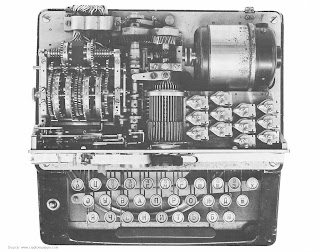
Sovietsky zväz používal počas II.svetovej vojny veľké množstvo 2,3,4 a 5-číselných kódov rozličného typu. Tieto boli všetko ručné systémy. Ak prišlo na strojové šifry v roku 1941 v službe využívali tri odlišné stroje  off-line šifrovací stroj K-37 ‘Krystal’ a šifrovacie ďalekopisy M-100 a B-4. K-37 bol kópiou Hagelinu s ozn. B-211 so znakmi azbuky na klávesnici. Podľa cryptomuseum.com  pred vypuknutím II. svetovej vojny bol Boris Hagelin prinútený (švédskymi vládnymi predstaviteľmi) predať dva takéto modely B-211 ruskej ambasáde. Rusi prevzali návrh a stroj okopírovali. V tom istom čase previedli maticu typu 5 x 5 na 5 x 6, aby ju tak prispôsobili väčšiemu počtu znakov. Tým dosiahli možnosť použitia 30 písmen azbuky. Podľa veľmi zaujímavého článku uvedenom na agentura.ru  ich výroba začala v Leningradskej továrni č. 209 v roku 1940 a od leta roku ’41 bolo v prevádzke zhruba 150 strojov K-37. Nemcom sa v roku 1941 podarilo ukoristiť jeden s...